A shirt is not cotton because the label says cotton. It is cotton of a certain staple length, combed or not, woven or knitted to a certain weight, and finished to behave a certain way on a humid platform and a 19°C office floor. Fabric is the part of clothing people argue about least and feel most. This guide is the whole map: every fibre we use, the sustainable fibres worth knowing, and the one we deliberately keep out of the wardrobe.
Natural · Plant
- Cotton
- Organic cotton Sustainable
- Linen / flax Sustainable
- Hemp Sustainable
- Jute
- Ramie
Every fibre at a glance
One screen, the properties that matter. Moisture regain is how much water a fibre holds at rest, a good proxy for how it handles sweat. The fibres that breathe are the fibres that absorb.
| Fibre | Family | Moisture regain | When wet | Wrinkles | Biodegradable |
|---|---|---|---|---|---|
| Cotton | Plant | ~8.5% | Stronger | Yes | Yes |
| Linen | Plant | ~11 to 12% | Stronger | Readily | Yes |
| Hemp | Plant | ~8 to 12% | Strong | Yes | Yes |
| Wool | Animal | ~16 to 18% | Holds | Resists | Yes |
| Silk | Animal | ~11% | Weaker | Resists | Yes |
| Viscose | Regenerated | ~12 to 13% | Much weaker | Readily | Yes |
| Lyocell | Regenerated | High | Holds well | Resists | Yes |
| Nylon | Synthetic | ~4% | Holds | Resists | No |
| Elastane | Synthetic | ~1 to 1.5% | Holds | Resists | No |
| Polyester | Synthetic | ~0.4% | Holds | Resists | No |
Fibres under the microscope
A cross section tells you a fibre’s shape. The surface, seen along its length, tells you how it behaves: whether it grips or slips, traps air or sheds it, holds water or repels it. Here is each fibre magnified, and what the structure means for the cloth on your back.
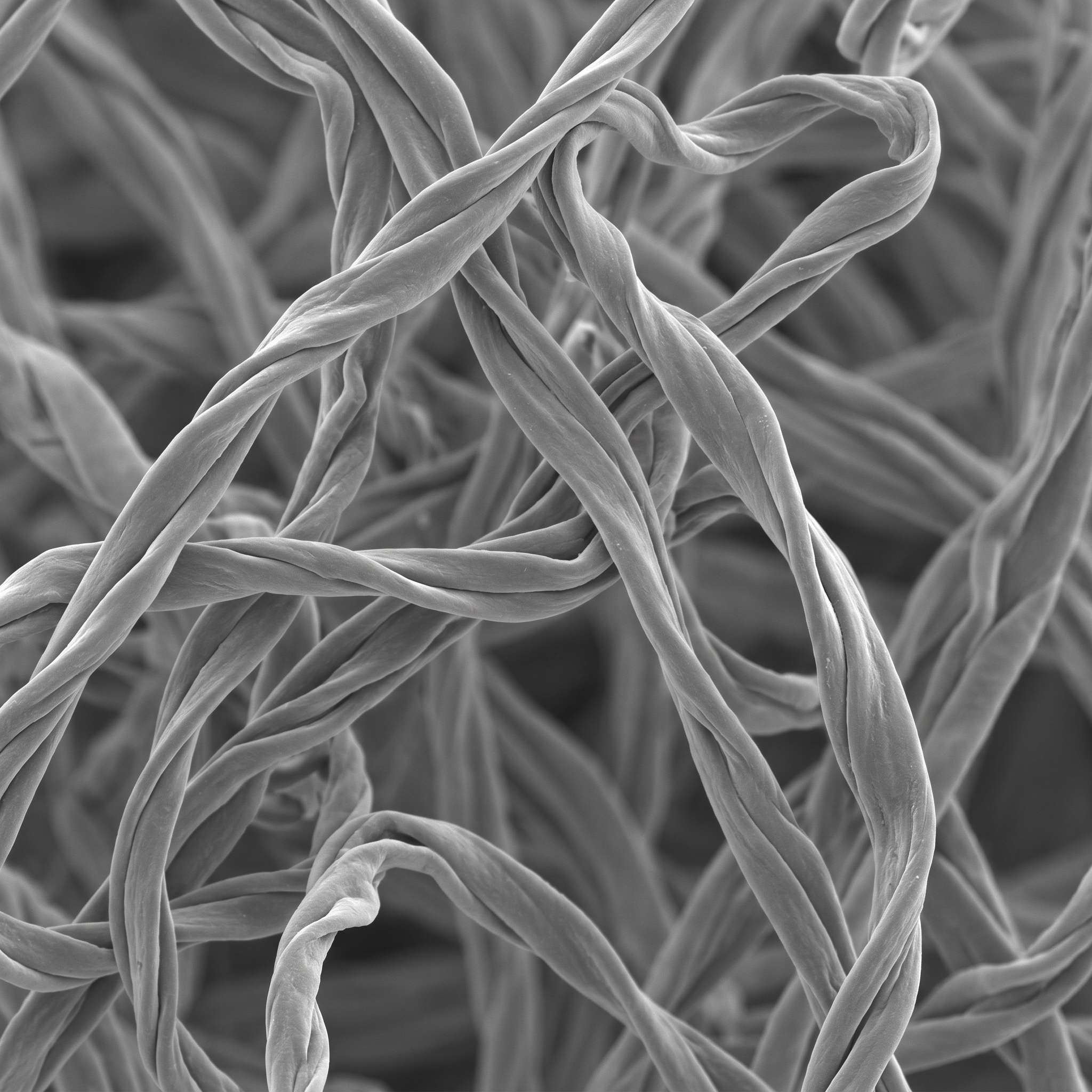
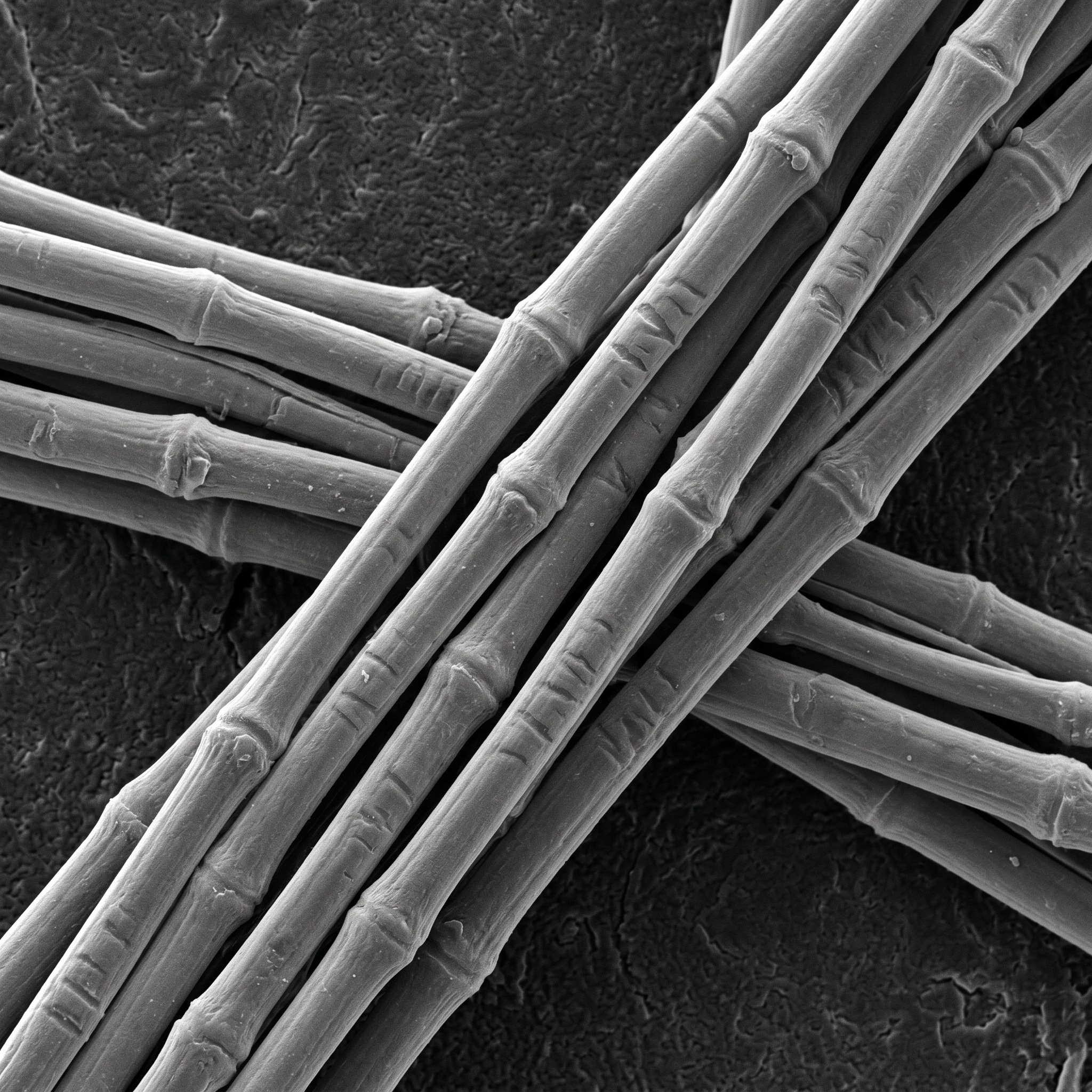
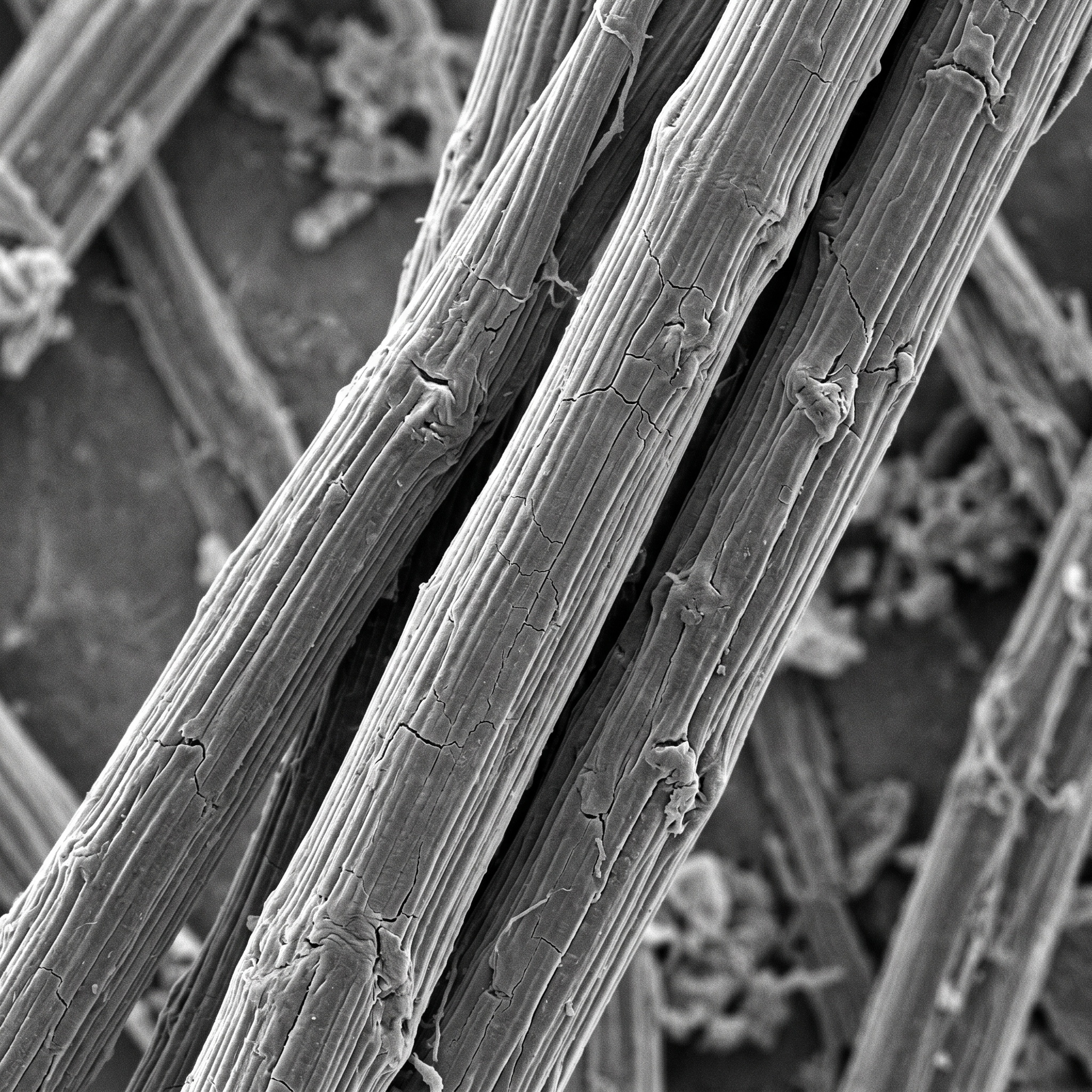
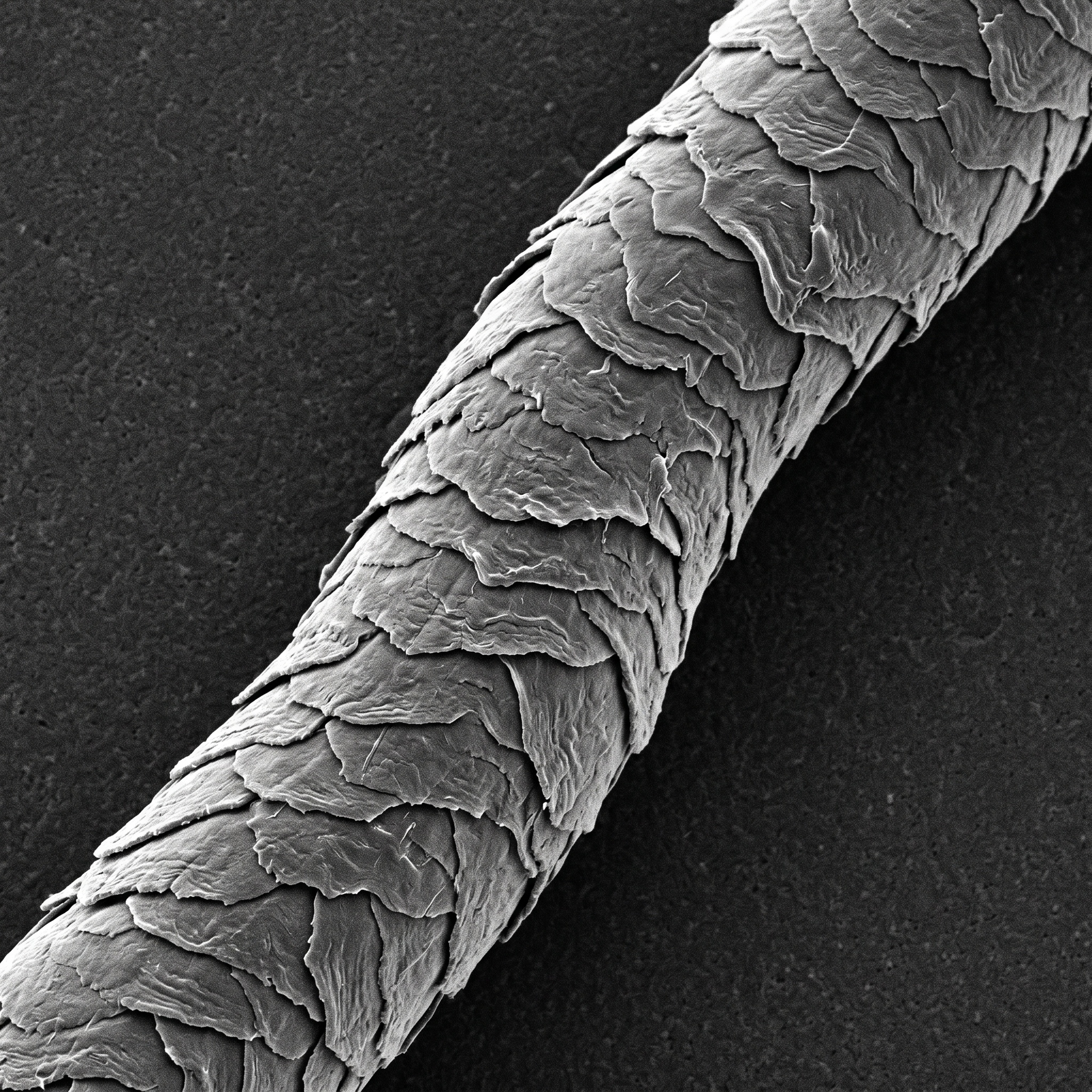
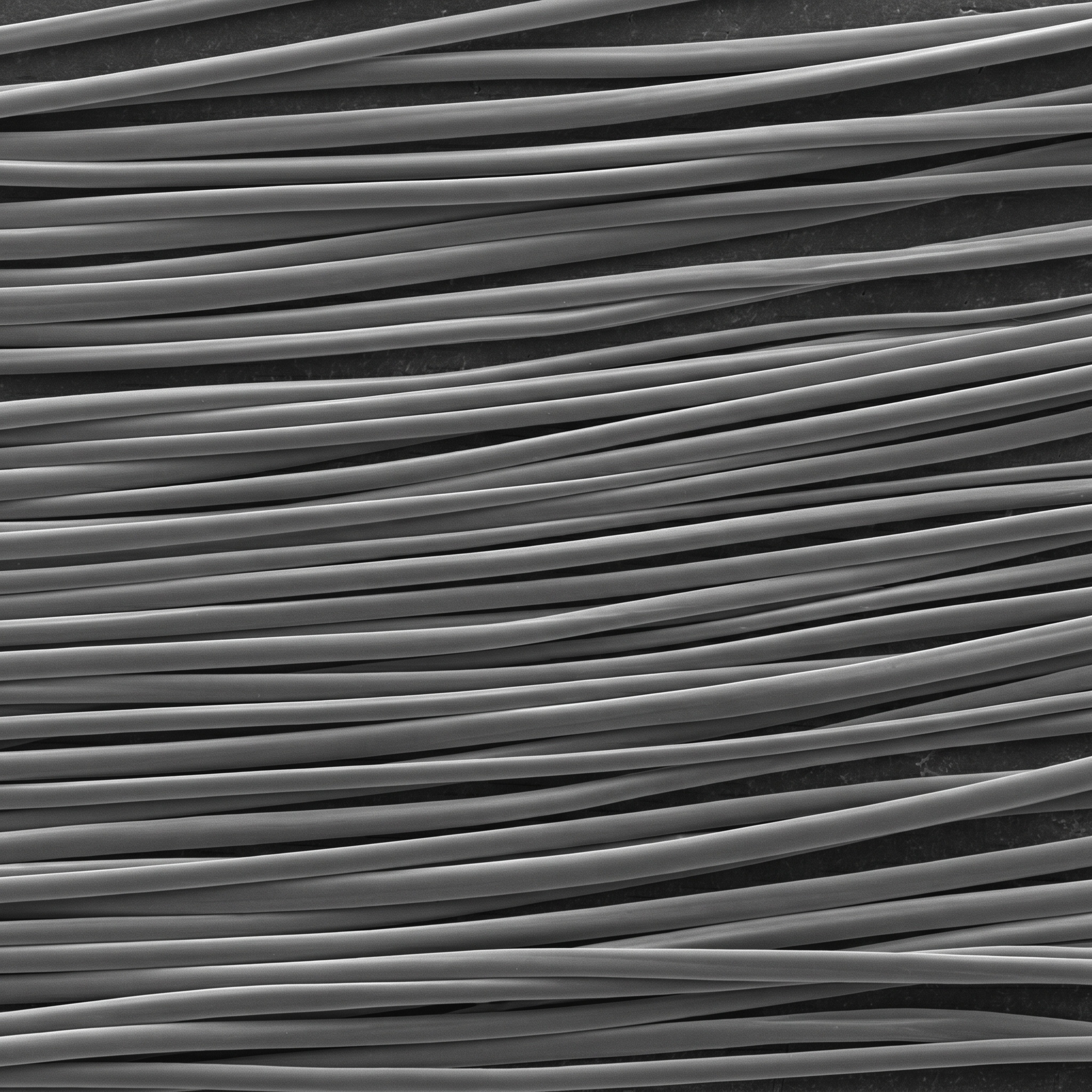
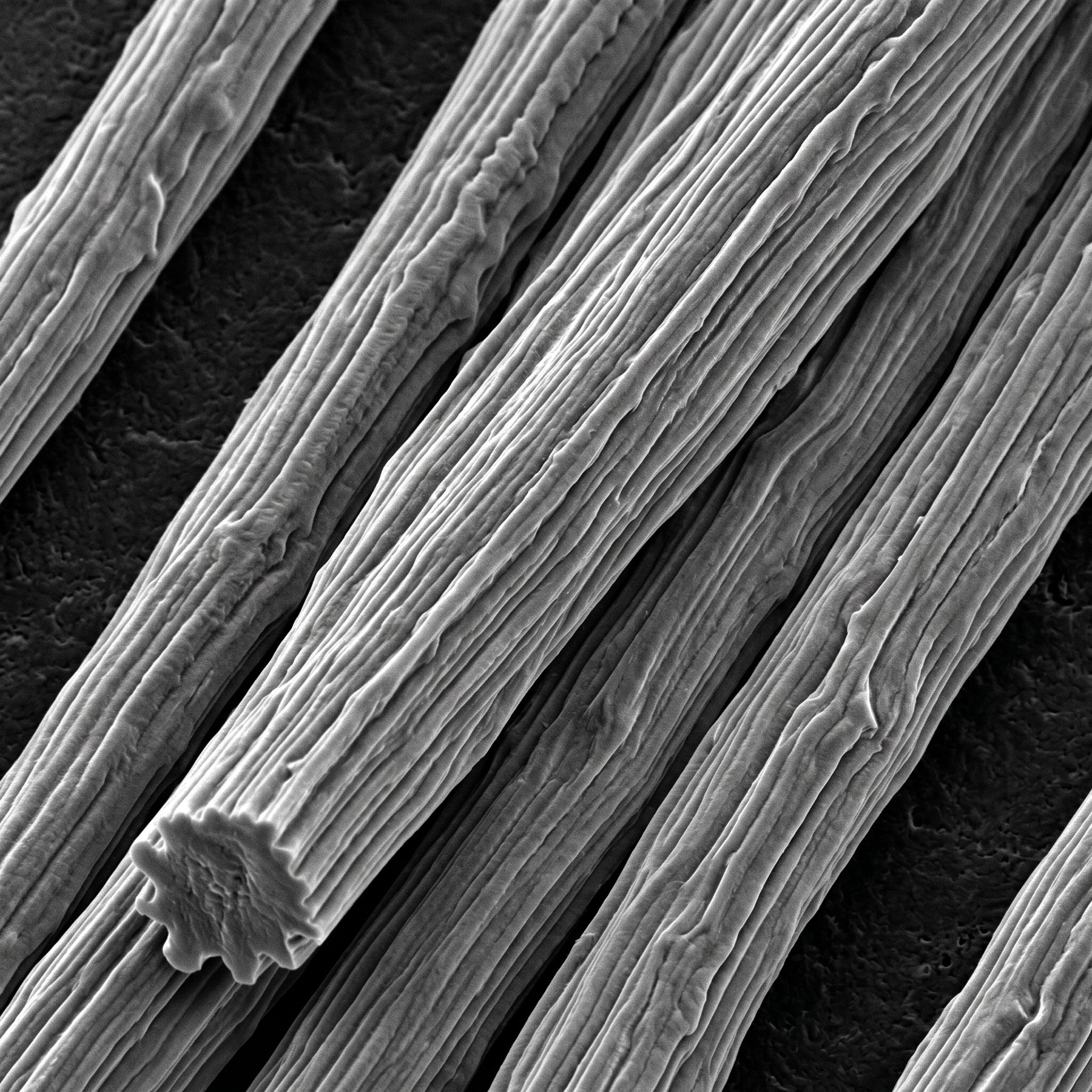
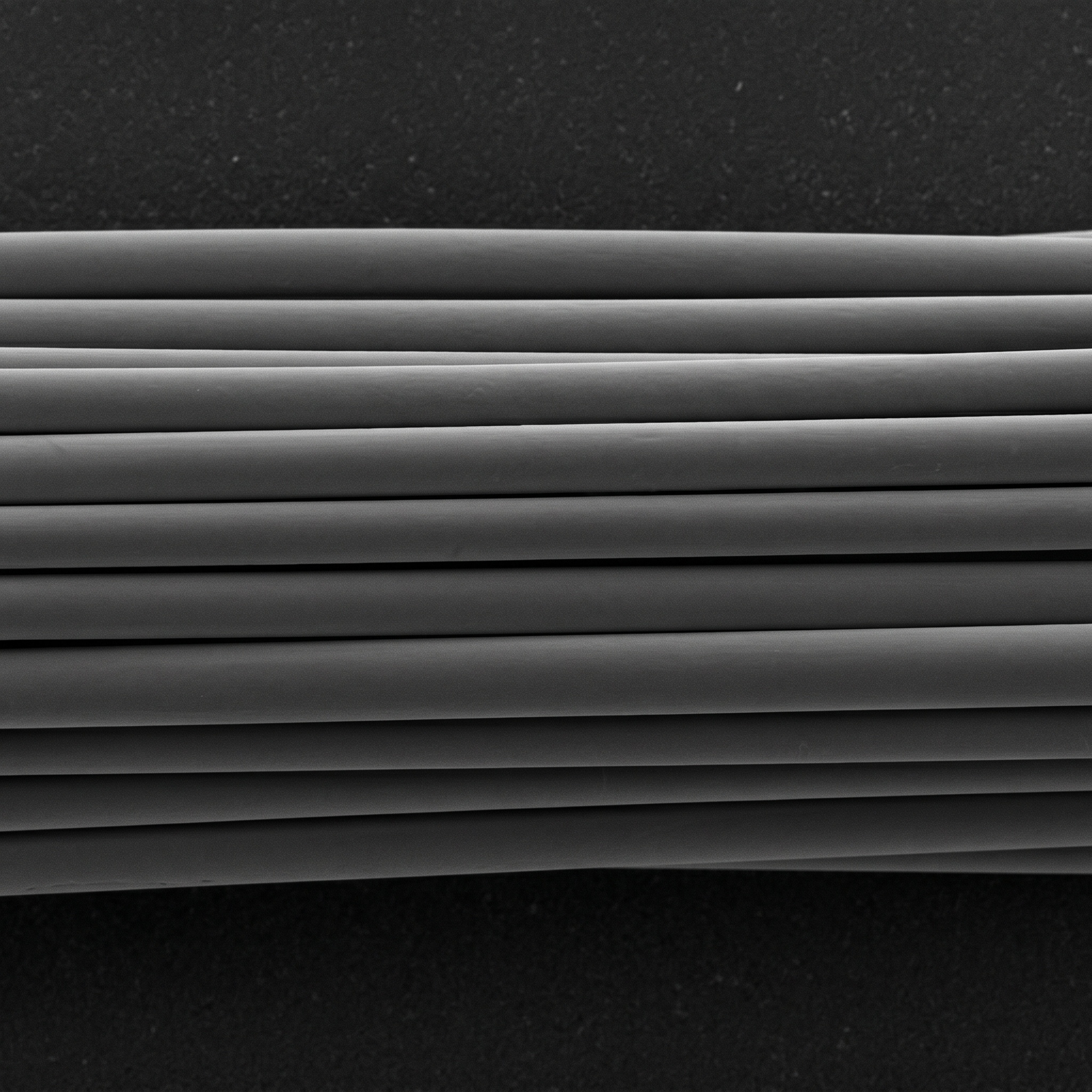
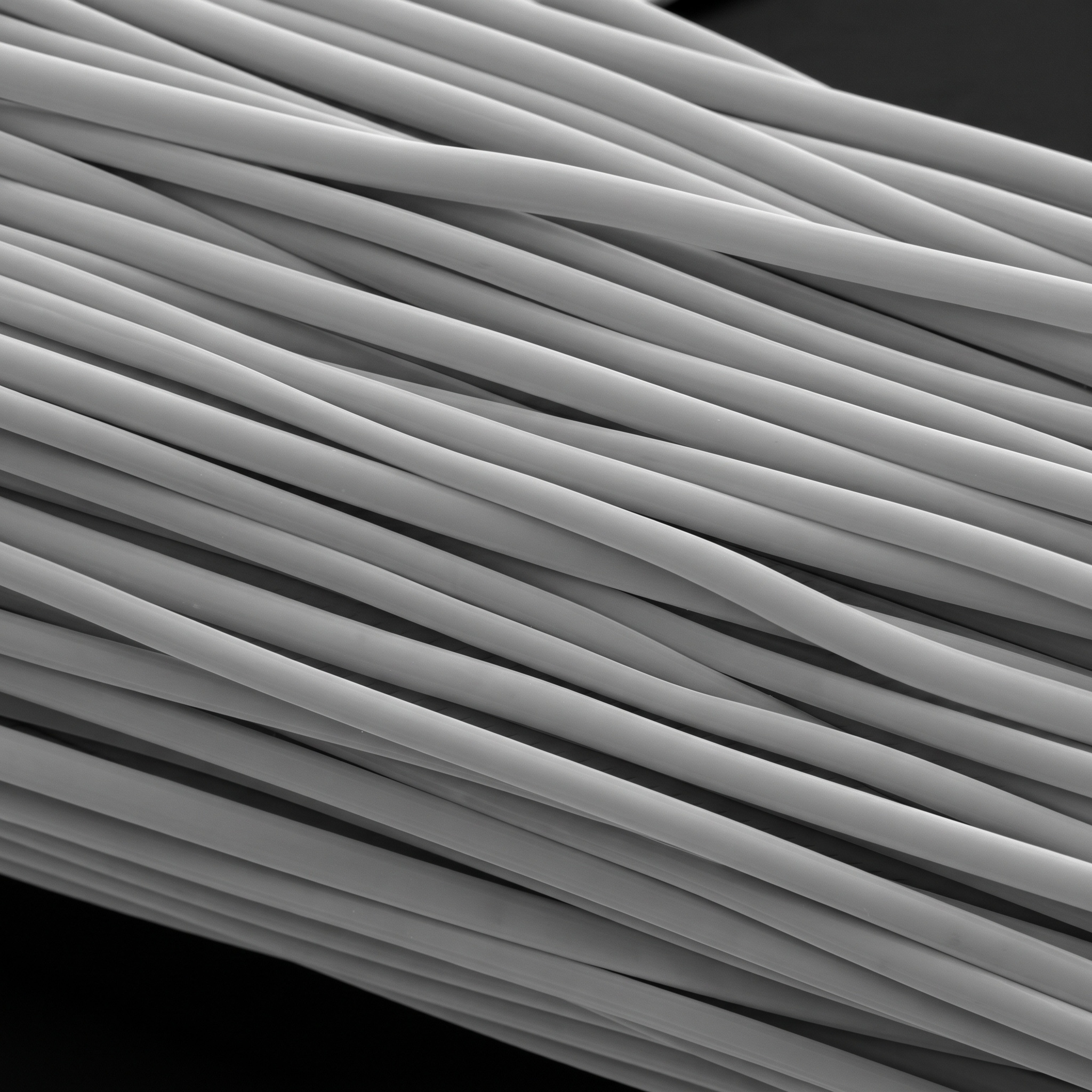
These are scientific illustrations of each fibre’s surface under magnification, drawn from documented fibre morphology. They are illustrations, not photographs or electron micrographs.
Natural fibres, from plants
Cellulose fibres, grown rather than synthesised. They share three habits that matter in Indian weather: they absorb moisture, they breathe, and they biodegrade at the end of their life. The differences are in strength, hand and how hard they crease.
Cotton
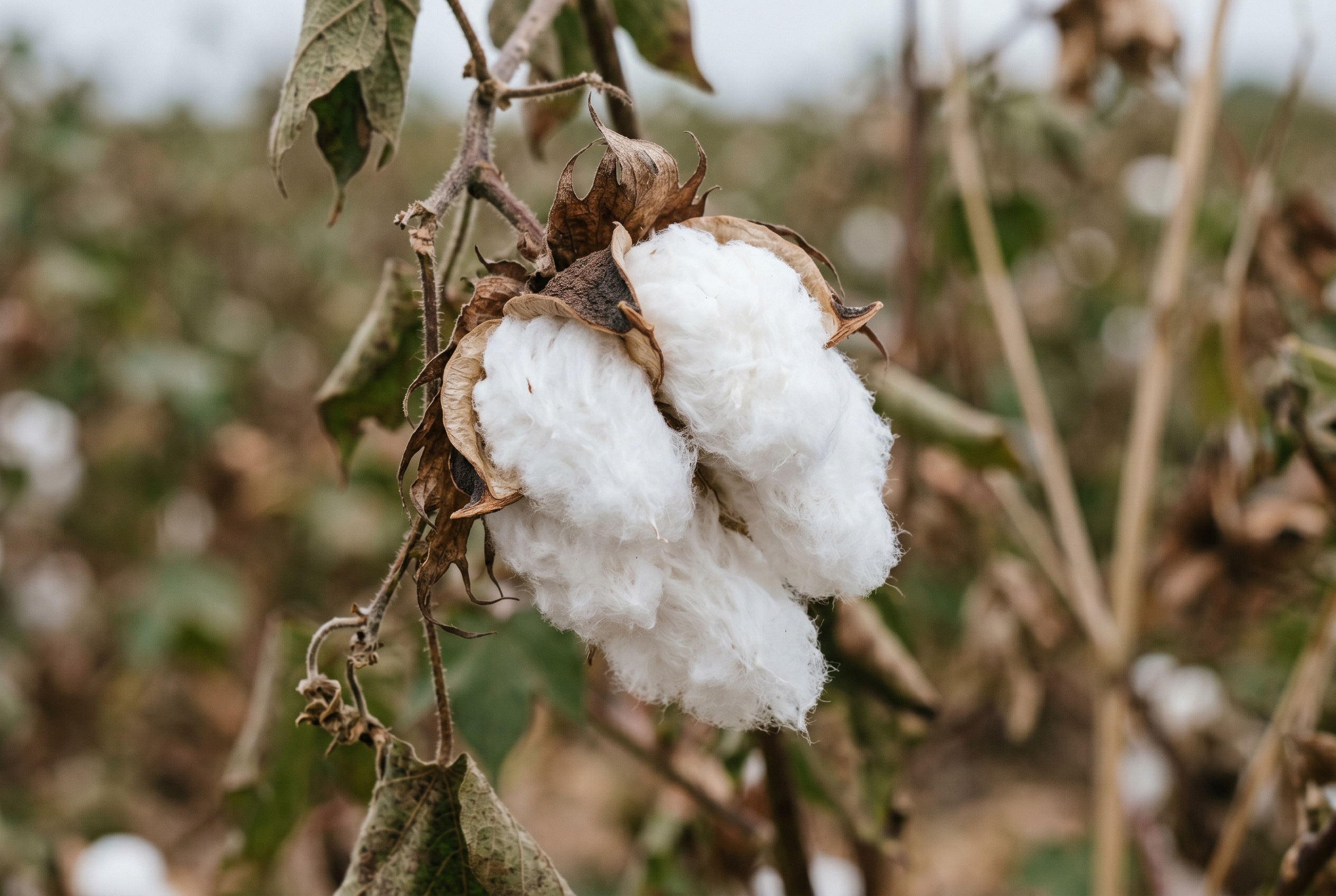
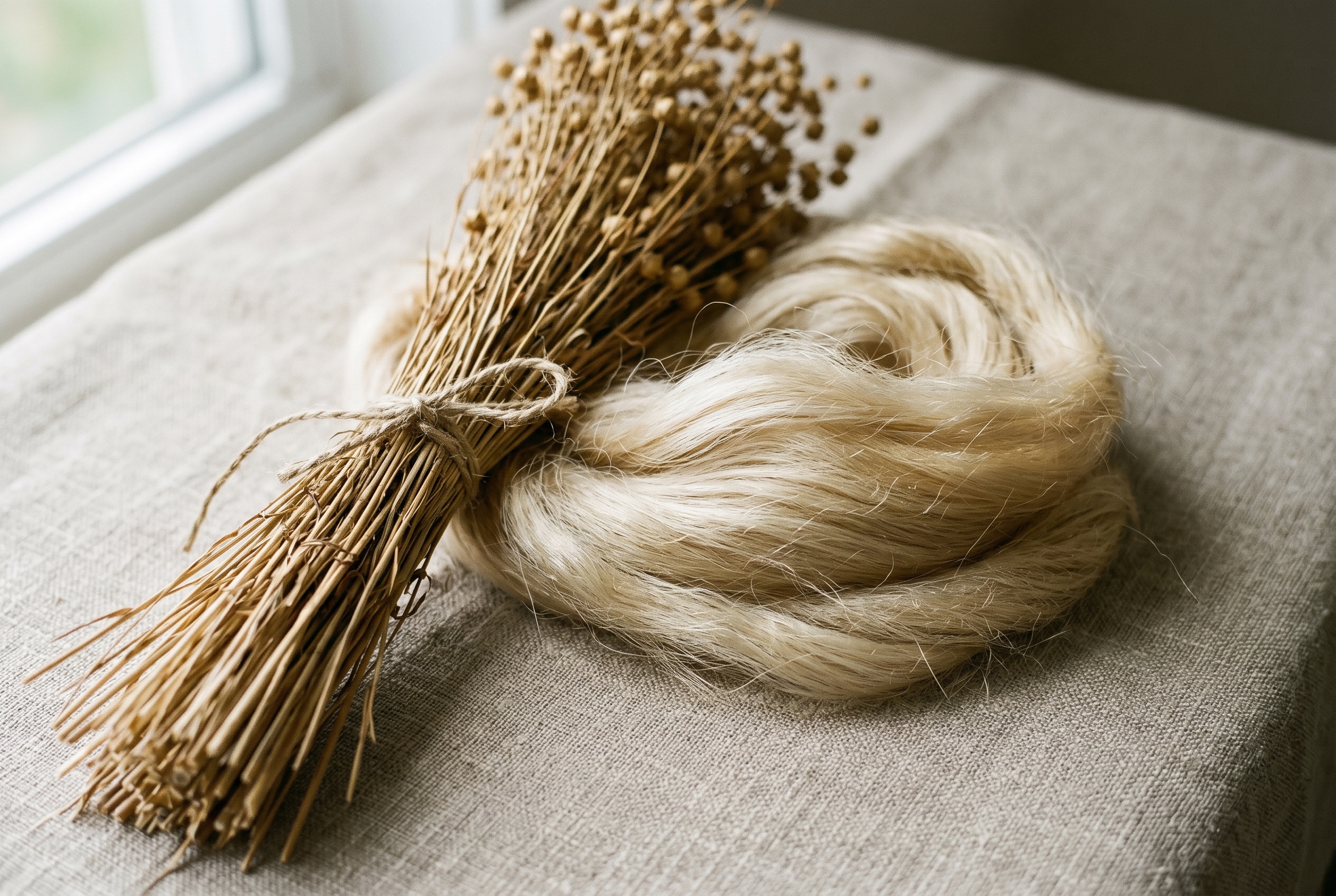
Cotton is near pure cellulose with a hollow, twisted cross section, which is why it is soft, breathable and good with moisture. The single biggest quality lever is staple length, the average length of the fibres. Longer fibres overlap more in the yarn, so they need fewer twist joins and spin into stronger, smoother, lower pilling cloth. This is why long staple and extra long staple cottons, Pima, Egyptian Giza, and India’s own Suvin, sit at the top. Two finishing steps separate everyday cotton from premium: combing, which removes the short fibres, and mercerisation, which treats the yarn under tension for lustre, strength and better dye uptake. Cotton is one of the few fibres that is actually stronger wet than dry. The Encyclopaedia Britannica classifies the finest cottons at a 2.5 to 6.5 cm staple.
Sigma Code is a cotton first brand. Our polos and shirts run 96% long staple cotton with 4% elastane, the long staple for a cleaner, stronger yarn, the elastane for recovery.
Organic cotton Sustainable
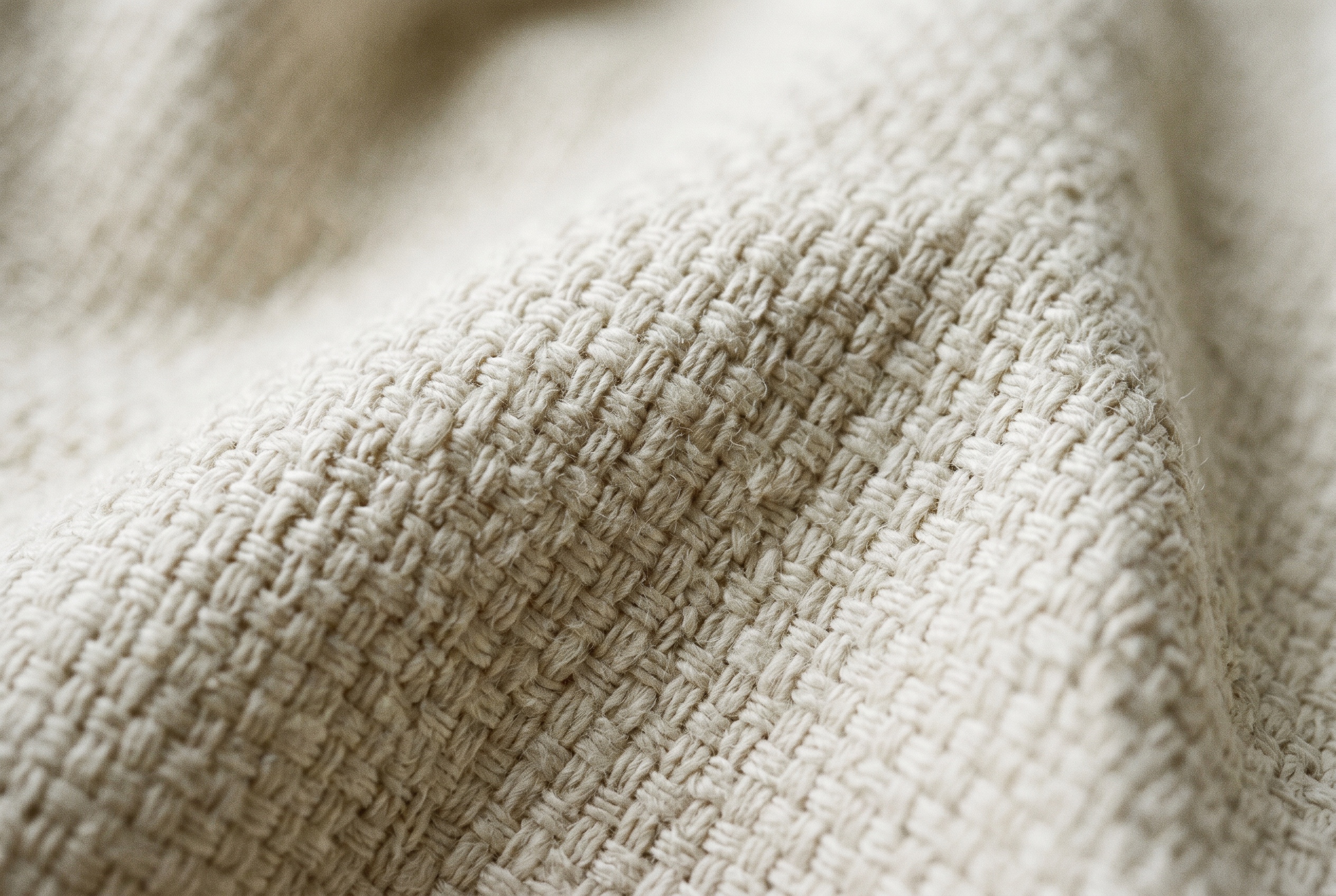
Organic cotton is the same fibre with a different field. Same staple physics, same moisture behaviour, grown without synthetic pesticides, herbicides or GMO seed. The recognised mark is GOTS, the Global Organic Textile Standard, which audits the whole supply chain, not just the farm. The environmental case is real: a life cycle assessment credits organic cotton with around 91% lower blue water use and 46% lower global warming potential than conventional cotton, which is one of the most chemically intensive crops there is. Like all cotton, it biodegrades far faster and more completely than synthetics.
Our 100% organic cotton shirts and shackets are the brand’s flagship sustainable plant fibre.
Linen, from flax Sustainable
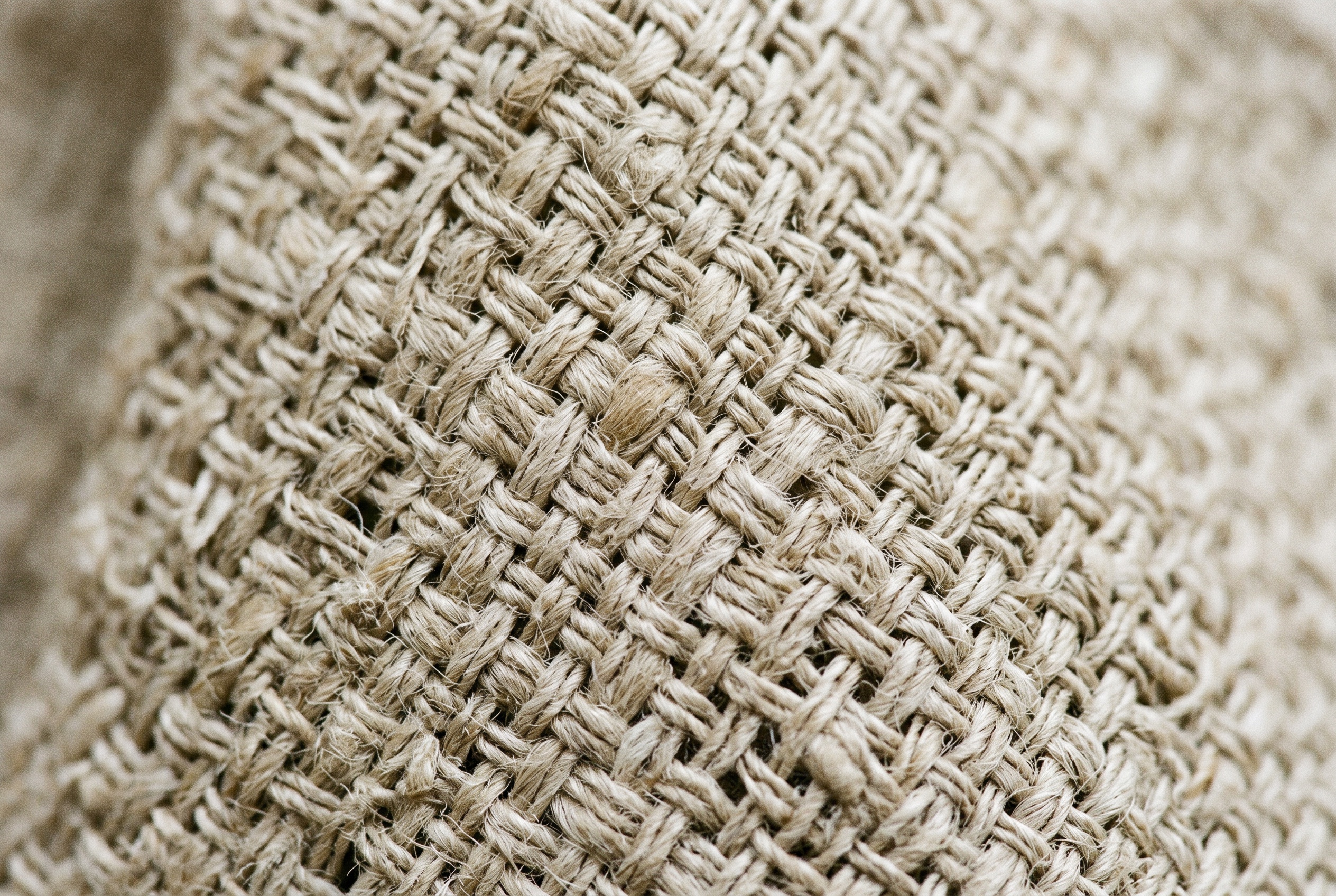
Linen is the stem fibre of the flax plant, highly crystalline cellulose, which makes it roughly two to three times stronger than cotton with a crisp, cool hand. It holds a lot of moisture, wicks well, and conducts heat away from the body efficiently, which is why it is the most comfortable plant fibre in real heat. The trade off is that it creases sharply, a look some people love and others iron out. Flax is also one of the strongest sustainability stories in fabric: in Western Europe it is almost always rain fed, naturally pest resistant and needs far less fertiliser than cotton.
Hemp Sustainable
Hemp is a bast fibre like linen, around 70% cellulose, with tensile strength higher than cotton and natural resistance to mildew, UV and bacteria. Untreated it is stiffer than cotton, so it is usually softened or blended. Agronomically it is hard to beat: it matures in about four months with minimal water and generally no pesticides, and improves the soil it grows in. A genuine sustainable hero for breathable hot weather cloth.
Jute
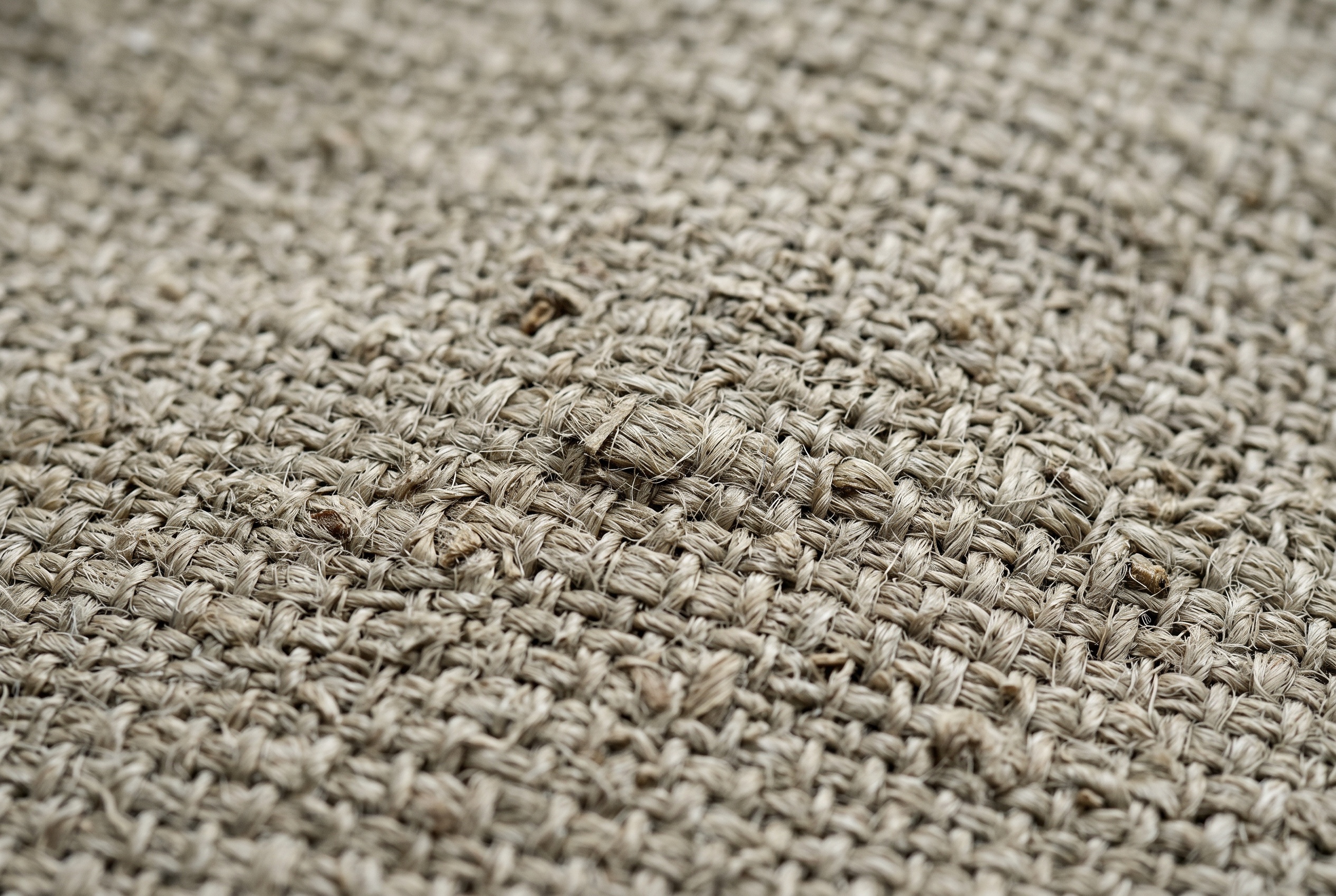
Jute, the “golden fibre”, is an Indian heritage crop grown across the Ganges delta. It is high in lignin, which makes it stiff, coarse and golden brown, brilliant for sacking, twine, rugs and packaging, less so for next to skin shirting. Worth knowing as a low impact, fully biodegradable Indian fibre, and increasingly as a plastic free packaging material rather than a garment fabric.
Ramie
Ramie, or China grass, is a nettle family bast fibre and one of the strongest natural fibres known, holding most of its strength even wet. It is crisp, lustrous and cool like linen, and creases just as hard. Processing is laborious, so it usually appears blended with cotton to soften the hand. For us, it is a credible linen alternative for crisp, breathable warm weather pieces.
↑ Back to the fabric mapNatural fibres, from animals
Protein fibres rather than cellulose. They behave differently from plant fibres in one important way: they manage temperature and odour better, which is why they are the quiet performers of any wardrobe.
Wool, and Merino
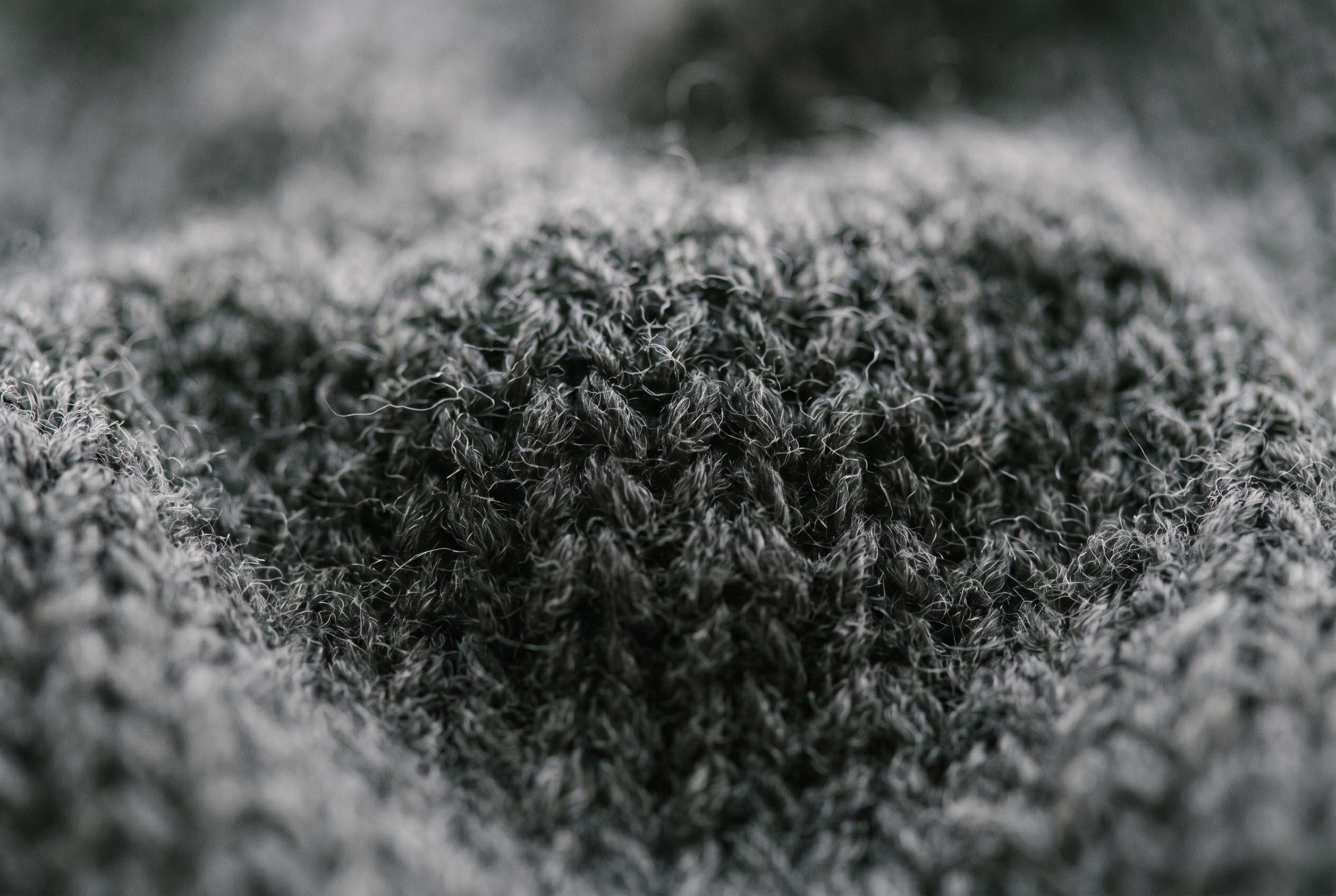
Wool is a protein (keratin) fibre with three dimensional crimp and a clever structure: a water repelling outer surface over a water loving interior. That lets it absorb a large amount of moisture vapour without feeling wet, the basis of its temperature regulation. Merino is the fine grade, soft enough for next to skin wear. Wool also resists odour, because it binds smell molecules inside the fibre where bacteria struggle, and it is fully biodegradable, releasing nutrients back to the soil. In a country that runs hot, fine wool is underrated for cool winter mornings and over air conditioned offices.
Silk
Silk is a continuous protein filament with a triangular cross section, which is what gives it that signature lustre. It is strong for a natural fibre, drapes beautifully, takes up moisture well and feels cool then warm as conditions change. It is delicate to sunlight, perspiration and abrasion, so it rewards gentle care. A luxury fibre, biodegradable, with no microplastic footprint.
↑ Back to the fabric map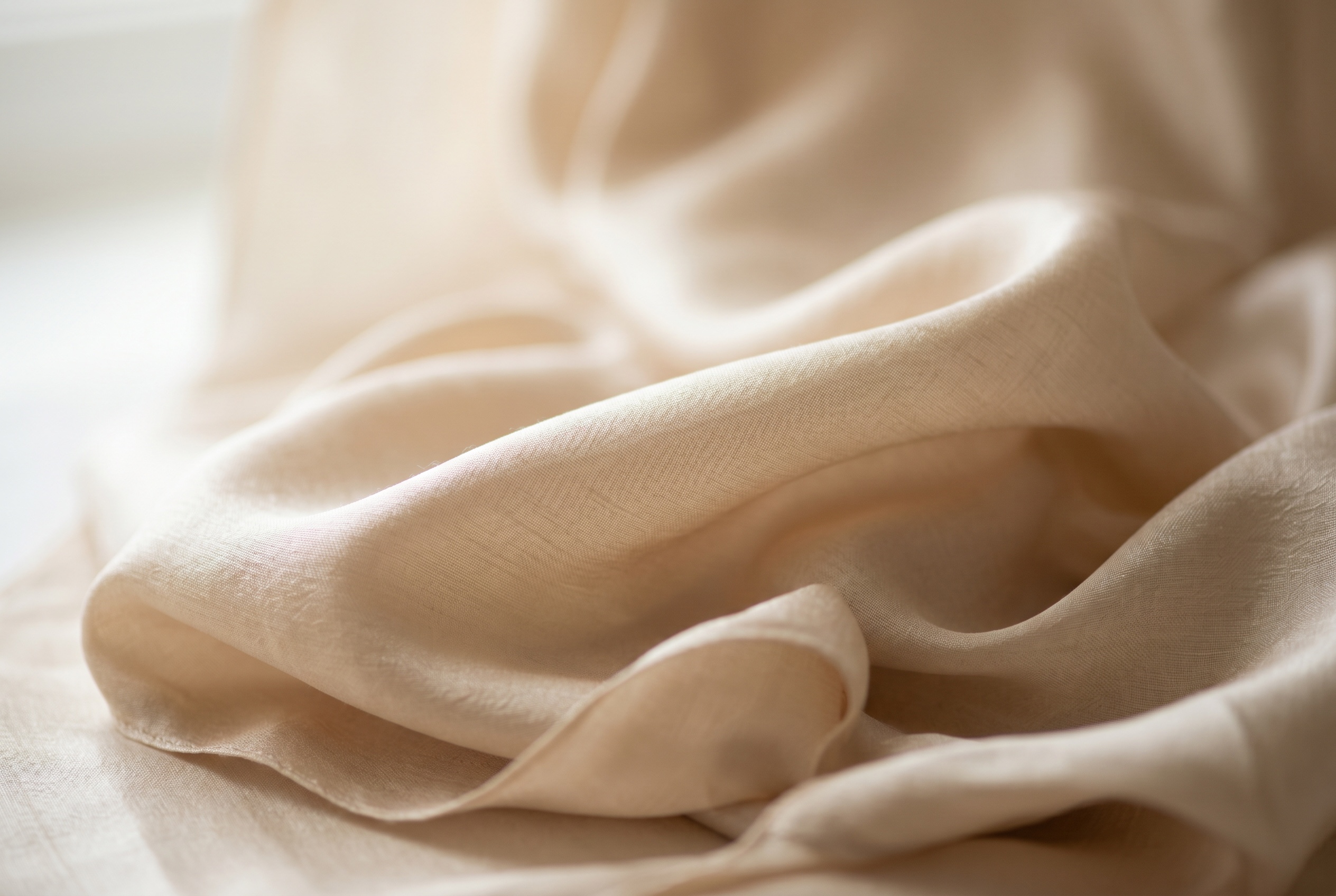
Regenerated fibres, the sustainable middle
Neither grown as a fibre nor synthesised from oil. These start as plant cellulose, usually wood pulp, that is dissolved and spun into a new fibre. The family runs from problematic to genuinely sustainable, and the difference is entirely in the process.
Viscose, or rayon
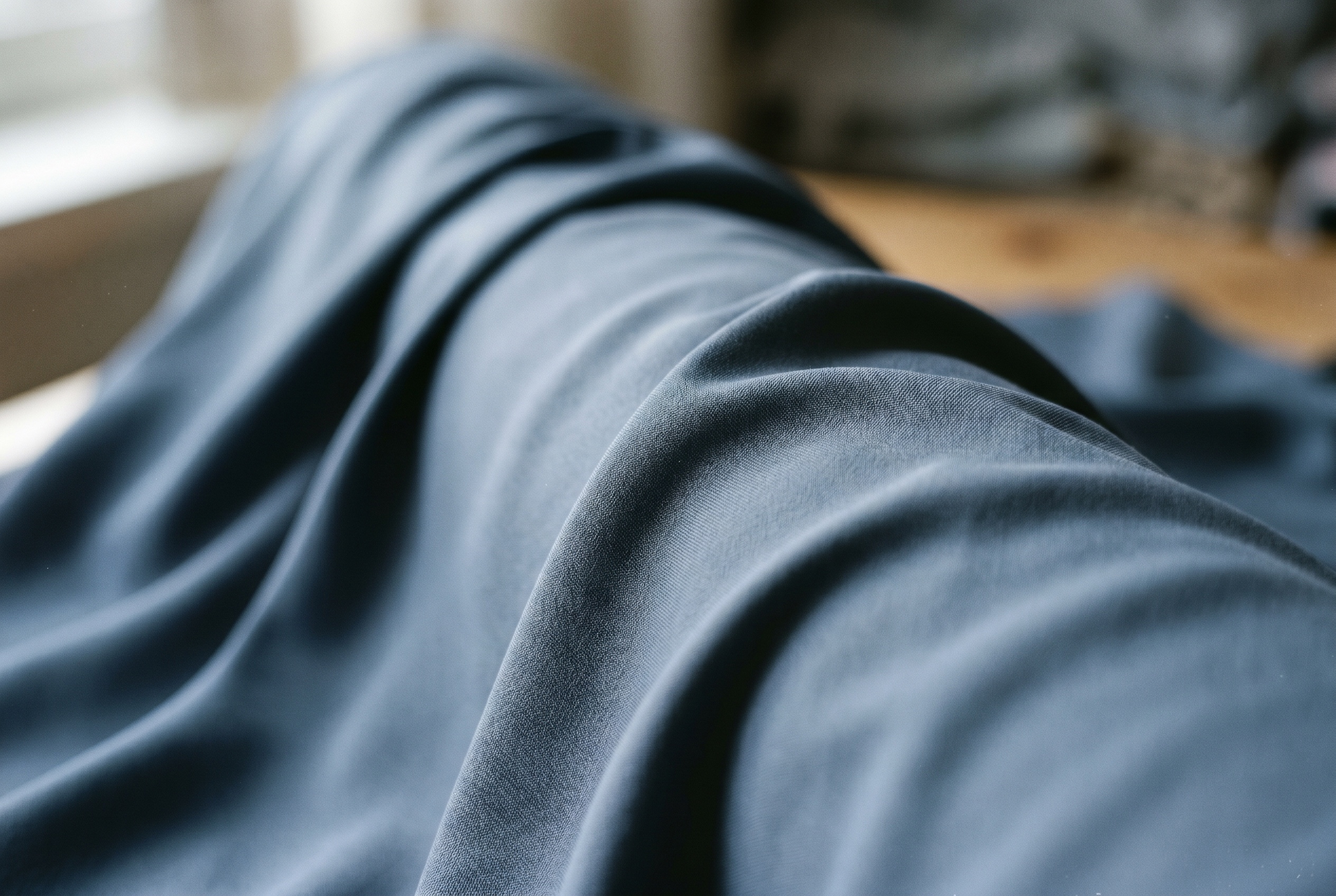
Viscose is the original regenerated cellulose. Chemically it is cellulose, like cotton, but with a far more amorphous internal structure, which makes it drape fluidly, absorb well and dye brilliantly, while losing roughly half its strength when wet. It is the dominant man made cellulosic, around 80% of the category. The honest concerns are two: forests, since over 200 million trees are logged each year for cellulosic fabric, some from ancient and endangered forests, and the hazardous carbon disulfide chemistry of the older process. Look for FSC certified pulp and closed loop variants.
Our trousers use a 75% viscose blend for exactly its strengths, drape and breathability, with 20% nylon and 5% elastane added to fix viscose’s weak spots: wet strength and recovery.
Modal
Modal is a second generation rayon, made mostly from beech, with higher molecular orientation than viscose. The practical result is that it keeps much more of its strength when wet, resists shrinkage and pilling, and feels softer. A clear step up from standard viscose, and a reasonable sustainable choice when the wood is responsibly sourced.
Lyocell, or TENCEL Sustainable
Lyocell is the third generation and the sustainable star of the family. It is made by dissolving wood pulp in a non toxic solvent that runs in a closed loop and is recovered at over 99%, with no carbon disulfide. The fibre comes out strong: it is the only regenerated cellulose with wet strength exceeding cotton. It is highly absorbent and breathable, and it is biodegradable. Its one quirk is a tendency to fibrillate under wet abrasion, which finishing controls.
Cupro
Cupro is a regenerated cellulose made from cotton linter, the short fuzz on the cottonseed that is too small to spin. It mimics silk: smooth, fluid, breathable, anti static, and is most often used as a premium lining. Like viscose it is weak when wet; its sustainability depends on closed loop recovery of its copper and ammonia chemistry.
↑ Back to the fabric mapSynthetic fibres, from petroleum
Made by melting and extruding polymers derived from oil. Two of them, nylon and elastane, do a specific functional job well in small amounts. The third, polyester, is the one we keep out of the wardrobe, and the reasons are documented rather than aesthetic.
Nylon, or polyamide
Nylon has an outstanding strength to weight ratio and excellent abrasion resistance, which is its whole reason to exist in our line. In a trouser blend, around 20% nylon buys durability and shape holding that viscose alone cannot. It has low moisture regain, around 4%, so it dries fast. Its downsides are honest ones: it is petroleum derived, sensitive to heat, prone to static, and it sheds microfibres in the wash, though notably less than polyester. We keep it a minority reinforcement, never the next to skin majority.
Elastane, or spandex
Elastane is the fibre that makes a few percent transform a garment. It is a segmented polyurethane that can stretch several times its length and snap back, which is why 4 to 5% gives a shirt or trouser comfort stretch and shape retention. It is never worn alone and never load bearing. Its limits set its care: heat and chlorine degrade it permanently, which is exactly why our stretch pieces are cold wash, no bleach, no tumble dry. Used well and cared for right, it is the difference between a trouser that holds its shape and one that bags out at the knee.
Polyester We avoid
Polyester is the world’s most used apparel fibre and, on the measures that matter to a hot climate brand built around comfort and longevity, the most problematic. We do not use it in our core line. This is the evidence, not the opinion.
It sheds plastic into the water. A foundational study in Environmental Science and Technology found that microplastic on shorelines worldwide is dominated by synthetic clothing fibres, with a single garment capable of shedding over 1,900 fibres in one wash (Browne et al., 2011). The IUCN estimates that around 35% of ocean microplastics come from laundering synthetic textiles, and laundering trials show polyester shedding several times more microfibre than nylon.
It holds sweat and breeds odour. Polyester’s moisture regain is only about 0.4%, against roughly 8.5% for cotton, so it does not absorb sweat. Worse, research shows polyester garments smell significantly more unpleasant than cotton after wear, because the fibre’s hydrophobic surface attracts more odour causing bacteria and the sebum they feed on. In Indian heat, that is the whole problem in one fibre.
It traps heat and it persists. A wear trial in Scientific Reports found a high polyester layer had worse water vapour resistance than a cotton rich blend, hurting comfort in heat. And while it does eventually break down, a 2024 burial study found cotton and rayon vanished within a month while polyester showed only the first signs of degradation after six months. Most “recycled” polyester, meanwhile, is downcycled from bottles, not old clothes.
How fabric is built: weave and knit
The same fibre behaves differently depending on how the yarn is assembled. Woven fabrics interlace two sets of yarn, so they are more stable, crisper and hold a press. Knits loop a single yarn, so they stretch, breathe and drape soft.
| Construction | Type | Character | Where it is used |
|---|---|---|---|
| Poplin / broadcloth | Weave | Fine, smooth, crisp, breathable | Formal and dress shirts |
| Oxford | Weave | Textured basketweave, durable, casual | Casual button downs |
| Twill | Weave | Diagonal rib, soft drape, very durable, hides creases | Chinos, trousers, denim |
| Herringbone | Weave | Reversed twill, subtle V texture | Trousers, smart shirting |
| Single jersey | Knit | Light, stretchy, breathable, curls at edges | T-shirts |
| Pique | Knit | Textured waffle, structured, holds shape | Polo shirts |
| Interlock | Knit | Double knit, smooth both sides, stable | Premium tees and polos |
What GSM means
GSM is grams per square metre, the weight of a one metre square of fabric, measured to standards such as ISO 3801. It is the best single proxy for thickness, opacity, drape and durability. Higher GSM is heavier, warmer and tougher, but less breathable. For Indian heat, lighter is usually cooler.
| Garment | Light / summer | Heavy / winter |
|---|---|---|
| Shirting | ~100 to 150 GSM | 180 GSM and up |
| Polos and tees (knit) | ~120 to 180 GSM | 200 to 300 GSM |
| Trousers and chinos (twill) | ~250 to 300 GSM | 350 to 450 GSM |
Caring for each fibre
Care rules are not arbitrary. They follow from two things: how much water a fibre absorbs, and what heat or chemicals it tolerates. That is why two Sigma Code garments need opposite care.
- 100% organic cotton, dry clean preferred. Cotton absorbs water, swells, and can shrink or distort under hot agitation. On a premium organic cotton piece, dry cleaning protects the structure and finish. It can be washed cold, but the finish lasts longer dry cleaned.
- Viscose, nylon and elastane blend, cold machine wash. The blend is limited by its weakest links. Viscose is weak when wet, and elastane loses its stretch permanently with heat and chlorine. So: cold water, no bleach, no tumble dry. That single rule protects all three fibres at once.
References and further reading
The technical claims on this page are drawn from peer reviewed journals and recognised textile and standards bodies. The key sources:
- Encyclopaedia Britannica. Cotton fibre classification and staple length.
- Global Organic Textile Standard. Organic cotton, GOTS key features.
- Textile Exchange / GOTS. Organic vs conventional cotton, life cycle assessment.
- Cotton Incorporated. Biodegradability of cotton vs synthetics.
- Alliance for European Flax-Linen and Hemp. Flax and linen, environmental profile.
- US National Library of Medicine (PMC). Industrial hemp as a low impact fibre crop.
- The Woolmark Company. Wool biodegradability and composition.
- Textile Exchange. Viscose, the dominant man-made cellulosic.
- Canopy. Forests and cellulosic fabric.
- US Federal Trade Commission. Bamboo textile labelling rule.
- BioResources (NC State University). Lyocell process and properties, peer-reviewed review.
- Cellulose (Springer). Fibrillation of lyocell fibres.
- Browne et al., Environmental Science and Technology, 2011. Microplastic fibres on shorelines worldwide.
- Boucher and Friot, IUCN, 2017. Primary microplastics in the oceans.
- Marine Pollution Bulletin, 2019. Microfibre release during laundering.
- Callewaert et al., Applied and Environmental Microbiology, 2014. Polyester and body odour after wear.
- Mollebjerg et al., Microbiology Spectrum, 2021. Fibre hydrophobicity and bacterial growth in textiles.
- Marine Pollution Bulletin, 2024. Relative degradation of polyester vs cotton and rayon.
- Scientific Reports (Nature), 2023. Thermal comfort and water vapour resistance of polyester blends.
- Textile Exchange, Materials Market Report 2025. Global fibre output and recycled polyester sourcing.
- ISO 3801 / ASTM D3776. Fabric mass per unit area (GSM) test method.